 Software development
 Web design
 Artificial intelligence
What we build
Systems people use every day
Internal systems
Give your team one place to manage inventory, billing, or records, without chasing updates across separate files.
Products with users
Let customers book, pay, and access information through your own platform, with accounts and permissions suited to each user.
Mobile apps
iOS and Android apps connected to your systems, so staff can record information in the field and customers can access your services on their phones.
Integrations
Connect invoicing, payments, messaging, and your existing business software so your team spends less time copying data between systems.
How we work
How your project takes shape
- 01
Discovery
We discuss your needs and review what you already have. Together, we define the first version and agree on a quote before work begins.
- 02
Design
You see the screens before we write code. Clickable prototypes, so you can change course while changing a screen still costs little.
- 03
Build
You get working progress to try throughout development. Your feedback helps us resolve questions before the final delivery.
- 04
Launch and after
We prepare the launch and agree on a maintenance plan covering updates, backups, and issues that arise once people start using the system.
Technology
What your system is made of
A system is like a building: what you see is a small part of what holds it up. These are the parts, and what we build each one with.
The facade
Interface
What you see and touch: screens, forms, buttons. It has to be fast and clear.
 TypeScript
 React
React
 Astro
Astro Vue
Vue Tailwind CSS
The garage
Mobile app
The iOS and Android app can use the camera, send notifications, and record location when your workflow calls for it.

 Apple
Apple Android
 React Native
 Expo
Expo
The structure
Server
Where the rules of your business live: who can do what, what gets calculated, what gets sent. It keeps working even when nobody is looking.
 PHP
PHP Laravel
 Node.js
 Python
 Go
Go
 Rust
Rust Ruby
Ruby
The foundation
Data
Everything your business knows, stored in order with a daily backup. This is the part that's hardest to move later, so we decide it well from the start.
 PostgreSQL
 MySQL
MySQL SQL Server
 MongoDB
The ground
Infrastructure
The servers everything runs on, the network that protects it, and what pages you when something fails. We pick it by size and budget, and we run it.

 AWS
AWS DigitalOcean
 Vercel
 Cloudflare
The electricity
Artificial intelligence
Ask questions about your documents, extract invoice data, or prepare drafts for your team to review.
 Claude
 OpenAI
 Gemini
 Grok
Grok DeepSeek
In every project
Security and control of your software
Your business needs software it can use, review, and maintain. These considerations are part of how we develop it.

Security
We protect credentials and connections, with permissions that limit access to the information each person needs.
It's in your name
The repo, the domain, and the accounts are yours from day one. Your data exports when you want, and there's documentation so another team can pick it up.
Automated tests
Every change is tested on its own before it ships, so fixing one thing doesn't break another.

A staging environment
You see each change on a copy of the system before it reaches your users.
It works on a phone
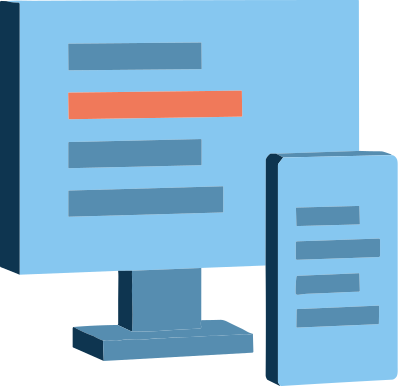
You open it on a phone and it's the same system, with the same screens.
Accessibility
It works with a keyboard, a screen reader, and large text.
Ours
Experience beyond launch
Running our own products gives us experience with the work your business will face after launch: supporting users, keeping data available, and making changes without disrupting daily operations.
We also do
Other ways we can help
Write to us
Tell us what your business needs and where the project stands. You don't need a technical specification to start the conversation.